Copyright © 2026. Encyclopedia Celia

On shrinking pleasures and a success story that may never reach the dinner table.
Monday, October 19th, 2026 — Encyclopedia Celia Team
In brief: Indonesia’s economic growth and household purchasing power can move differently. The lipstick effect offers one way to examine a shift toward affordable pleasures, but busy snack stalls alone cannot establish financial hardship. This opinion essay distinguishes the research evidence from an illustrative Indonesian example.
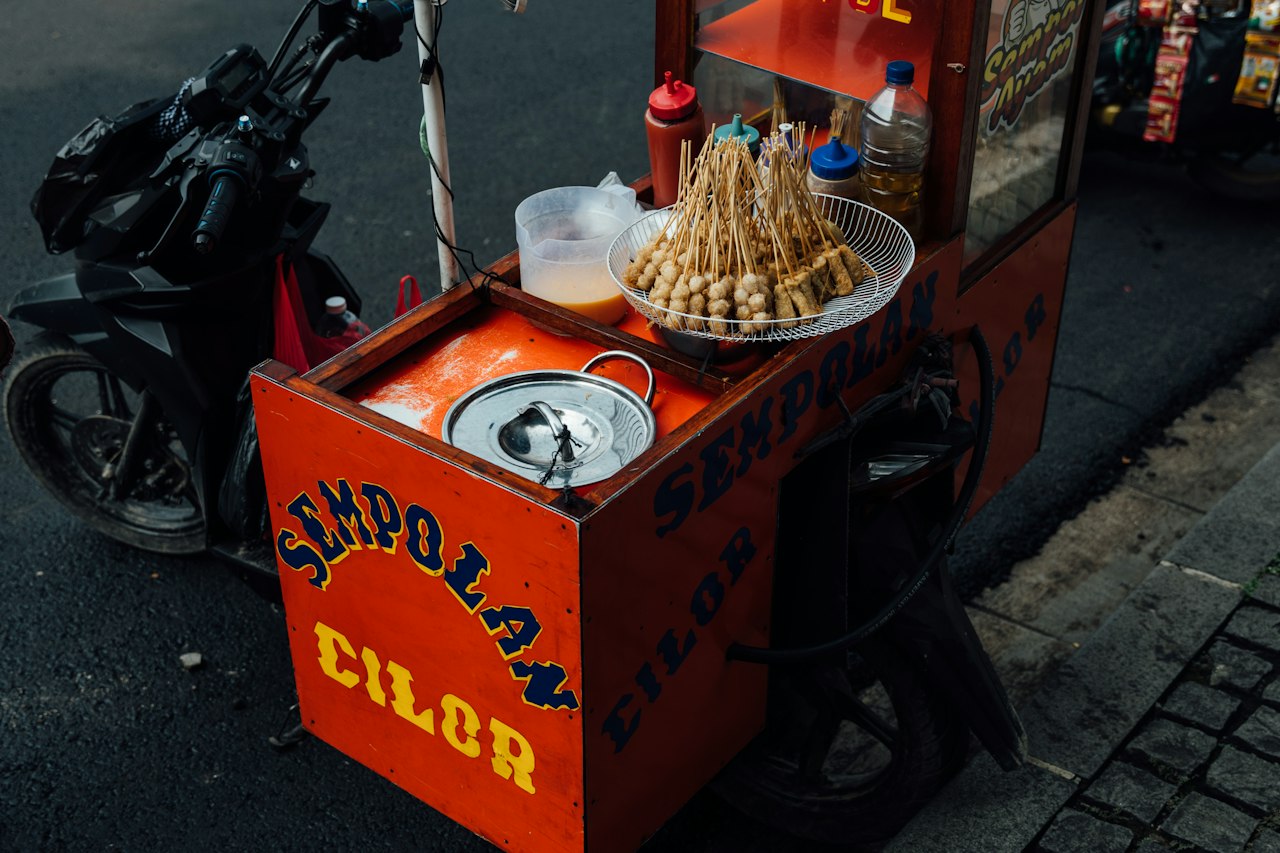
A few thousand rupiah for a bag of cilok—chewy tapioca balls sold as street food. Something warm to hold after a long day. For a moment, there is still a little money left to enjoy being alive.
Imagine someone who once ate at a restaurant occasionally but has since crossed that habit off their budget. A snack on the way home becomes a pleasure they can still afford. They keep spending, even as their choices narrow.
Is that transaction enough to say they are doing just fine?
If money changing hands is all it takes to establish prosperity, a bag of cilok apparently has quite a burden to bear: proving that the economy is working for the person buying it.
This illustration is not a survey finding. People buy cilok or tahu bulat—round, fried tofu—for their taste, convenience, or familiarity. The price of a snack cannot tell us someone’s bank balance. What deserves scrutiny is the change: what they could once afford, what they now cut back on, and why.
That question matters whenever bustling consumer activity is used to dismiss economic hardship. A transaction records money changing hands. It does not automatically record the sacrifices that made that spending possible.
What Is the Lipstick Effect?
In consumer research, the lipstick effect describes a phenomenon in which spending on cosmetics holds steady or increases during an economic downturn. One explanation is a shift from more expensive purchases toward more affordable pleasures.
Daniel MacDonald and Yasemin Dildar’s research on the Great Recession in the United States found increased cosmetics spending among women aged 18–40 alongside reduced spending on clothing. Their findings support the explanation that consumers substituted some purchases with a less expensive category.[1]
That research does not establish that busy street-food stalls in Indonesia reflect the same phenomenon. It does, however, offer a useful lens: economic pressure does not necessarily extinguish the desire to enjoy life. People may resize their pleasures to fit their budgets.
Extending this idea, inexpensive snacks might replace restaurant meals or more costly leisure activities. Establishing that would require tracking the same people’s spending over time and understanding their reasons. Busy stalls alone cannot tell us enough.
There is also a difference between buying a snack as a small treat and buying it to stave off hunger because a proper meal is unaffordable. The latter concerns a basic need. Conflating the two obscures the severity of the hardship involved.
Such distinctions strengthen the criticism. We need to understand what people are adjusting: their preferences, their leisure spending, or their ability to meet essential needs.
Indonesia’s Economy and Household Purchasing Power
In early October 2026, Indonesia’s Coordinating Ministry for Economic Affairs highlighted positive developments in inflation, trade, and manufacturing activity. Meanwhile, the National Economic Council’s September 2026 report acknowledged mounting pressure on the purchasing power of lower-middle-income households.[2][3]
Both accounts can be true. Citing positive indicators therefore does not settle the question of public well-being. Economic growth describes changes in production; household purchasing power concerns what people can afford with their income. The two measures answer different questions.
Good news at the national level certainly deserves recognition. Households would simply like to know when it will start helping with the bills.
National indicators summarize economic activity on a broad scale. Household circumstances depend on more specific factors: income, the prices of what people actually buy, the number of dependants, debt, and job security. An improvement in one measure does not guarantee that every family has more room to breathe.
Growth needs to be traced to its beneficiaries. Whose income has risen? Whose employment has become more secure? Who can save without cutting back on essentials? Until those questions are answered, claims of success still leave work unfinished.
A worker may keep spending while drawing down their savings. A family may maintain this month’s consumption by postponing next month’s needs. These are possibilities to investigate through data, rather than conclusions about all households. They nevertheless show why continued transactions cannot tell us everything about the people making them.
Does Consumer Spending Prove Economic Well-Being?
Consumer spending alone does not prove that households are financially secure. People can sustain purchases by using savings, taking on debt, or cutting other expenses. Establishing which explanation applies requires household-level evidence.
The choice of which figures to highlight has political consequences. It determines whose experiences enter the success story.
When positive indicators are used to conclude that society as a whole is doing well, the experiences of those struggling risk being pushed aside. Their complaints may sound like insignificant exceptions, even when they point to problems hidden within aggregate figures.
The government needs to explain the scope of its achievements: what has improved, for whom, and what remains unresolved. Success announced to the public must withstand scrutiny against the public’s own circumstances.
Acknowledging progress while recognizing hardship is part of accountability. Citizens have a right to know how policies affect their ability to meet basic needs, secure decent work, and handle unexpected expenses.
Resilience also comes at a cost. Adjusting may mean postponing medical treatment, compromising on food quality, or taking on additional work. These are possibilities to examine, not circumstances we can assume apply to everyone. But where resilience does depend on such sacrifices, the government needs to address their causes. Praising people’s ability to endure is insufficient as an account of policy performance.
Affordable Pleasures: Stop Putting Small Treats on Trial
Discussions of economic hardship often become entangled in judgments about individual choices. People who complain about money are asked why they still buy coffee, snacks, or small things they enjoy.
Managing money matters. But to assess whether a purchase explains someone’s hardship, we need to consider its cost relative to their income and other needs. One small purchase cannot account for someone’s entire financial situation.
A decent life leaves room for enjoyment. A bag of snacks after work may mean more than its price suggests.
Expecting people in difficulty to give up every pleasure can turn poverty into a test of deservingness: help and sympathy become available only after someone demonstrates a life of complete deprivation. By that standard, even a pleasure costing a few thousand rupiah can become an offence.
If small treats are indeed among the few pleasures people can still afford, the useful question is what has made their other choices increasingly inaccessible. The answer may involve personal decisions, alongside wages, living costs, working conditions, and social protection. The weight of each factor requires evidence.
How Should We Measure Household Economic Well-Being?
Household economic well-being should be assessed using income adjusted for inflation, job security, essential living costs, and the ability to withstand an unexpected expense or loss of earnings. Aggregate growth and continued shopping cannot establish all of these conditions.
“Indonesia is doing just fine—according to whom?” asks whose experiences a conclusion represents.
Answering it requires data closer to household life: changes in income after accounting for rising prices, job quality, the burden of essential expenses, and the ability to withstand a loss of earnings. It also requires people’s accounts of their lives, while recognizing that one person’s experience cannot represent an entire country.
The lipstick effect can help us formulate questions about changing consumption. It cannot diagnose Indonesia’s economy on its own. Cilok, tahu bulat, and other small pleasures are starting points for observation; evidence of changes in purchasing power must follow.
People who keep spending may indeed be enjoying the benefits of progress. Others may be preserving a little room to enjoy life after cutting back on much else.
Good policy must be able to distinguish between the two. So must the story told about its success.
Before celebrating resilient consumption as an achievement, we need to ask: what can people still afford, and what have they already been forced to give up?
The answer determines how justified anyone is in declaring, on their behalf, that everything is “just fine.”
Happy Monday. May the good news about the economy reach the dinner table soon. In the meantime, before declaring that people are doing well because they can still spend, perhaps we should ask what they have given up to keep doing so.
For another perspective on public accountability in Indonesia, read Smoke Knows No Borders: Indonesia’s Forest Fires, or explore more essays by Tanpa Lilin.
~ Tanpa Lilin ~
Featured photograph: a street food vendor in Jakarta. Photo by Ravigopal Kesari on Unsplash. Used for illustration.
References
1. MacDonald, D., & Dildar, Y. (2020). Social and psychological determinants of consumption: Evidence for the lipstick effect during the Great Recession. Journal of Behavioral and Experimental Economics, 86, 101527.
https://www.sciencedirect.com/science/article/pii/S2214804319304884
2. Coordinating Ministry for Economic Affairs of the Republic of Indonesia (3 October 2026). Tiga Indikator Ekonomi Menguat, Fundamental Perekonomian Indonesia Tetap Terjaga [Three Economic Indicators Strengthen, Indonesia’s Economic Fundamentals Remain Sound].
https://ekon.go.id/publikasi/detail/7126/tiga-indikator-ekonomi-menguat-fundamental-perekonomian-indonesia-tetap-terjaga
3. National Economic Council of the Republic of Indonesia (September 2026). Laporan Data Visual Dewan Ekonomi Nasional Bulan September 2026 [National Economic Council Visual Data Report, September 2026].
https://dewanekonomi.go.id/publikasi/laporan-data-visual-dewan-ekonomi-nasional-bulan-september-2026