Copyright © 2026. Encyclopedia Celia

When environmental activism goes viral, do we remember the message—or only the spectacle?
Wednesday, October 28, 2026 — By Tanpa Lilin
A banner can disappear from a monument in minutes. The question it raises, however, does not disappear with it.
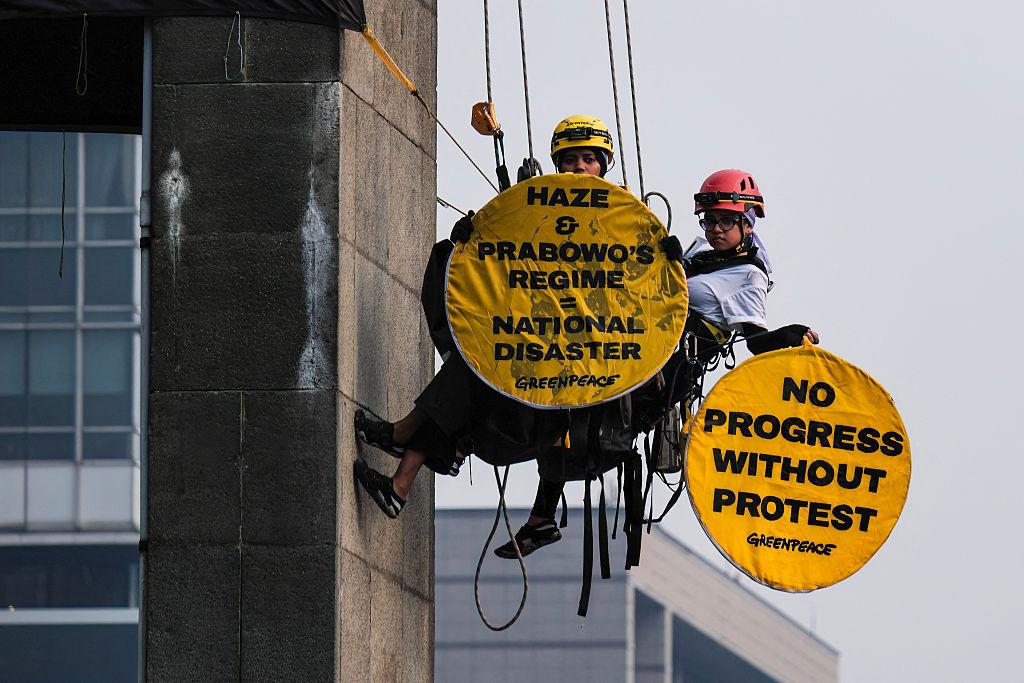
On October 20, 2026, Greenpeace Indonesia turned one of Jakarta’s most recognizable landmarks into a stage for environmental protest. Activists climbed the Welcome Monument at Bundaran Hotel Indonesia, unfurling two enormous banners demanding greater attention to the climate crisis and the rising cost of living.
Below them, Jakarta continued with its familiar rhythm. Traffic moved through the capital, people hurried toward their workplaces, and cameras captured the unusual sight of activists suspended from a monument that normally stands as a symbol of welcome.
Soon, the images travelled across social media. The action received extensive news coverage. Two female activists were celebrated online, while questions emerged about the police response and the appropriateness of using a public monument for political expression.
And somewhere between the photographs, the arguments, the applause, and the criticism, another question began to emerge:
Did people pay attention to what Greenpeace was saying, or merely to what Greenpeace was doing?
That distinction matters. Because the protest was never supposed to be the entire story.
It was supposed to draw attention to a crisis unfolding beyond the monument.
1. A Protest Designed to Be Seen
Greenpeace is no stranger to theatrical environmental activism. Its campaigns have frequently relied on striking imagery, symbolic locations, and highly visible demonstrations to bring complicated environmental issues into public conversation.
The October 20 action followed that tradition.
According to reports from The Jakarta Post, the activists displayed banners demanding action on the climate crisis, relief from rising living costs, and accountability for worsening disasters.
The protest coincided with the second anniversary of the Prabowo–Gibran administration, placing its message within a broader public discussion about the government’s environmental and economic policies.
The choice of Bundaran HI was significant.
Monuments are not simply physical structures. They are places where societies display their history, values, and collective identity. The Welcome Monument is particularly recognizable, standing at the centre of one of Jakarta’s busiest urban spaces.
By placing their message there, Greenpeace transformed an ordinary landmark into a temporary site of public debate.
But visibility comes with a paradox.
A dramatic protest can attract attention precisely because it interrupts the ordinary. Yet the interruption itself can become more interesting to audiences than the issue it was designed to expose.
People may debate whether the activists were courageous, whether the demonstration was appropriate, or whether authorities responded proportionately. These are legitimate questions.
Still, they are not the only questions worth asking.
The banners were not asking the public to admire a climbing performance.
They were asking people to consider how environmental degradation intersects with their everyday lives.
The spectacle was the vehicle. The climate crisis was the message.
2. The Crisis That Reaches the Dinner Table
Environmental discussions often begin with numbers that feel distant from everyday experience.
Global temperatures. Carbon emissions. Forest cover. International climate targets.
These measurements are indispensable to understanding environmental change. Yet their meaning can become abstract when disconnected from the people who live with the consequences.
For someone struggling to afford groceries, the language of climate negotiations may seem far removed from the immediate question of what can be placed on the dinner table.
Greenpeace attempted to connect these realities through its 2026 research, Besok Harga Naik! (Tomorrow, Prices Will Rise!).
The study examined the experiences of 361 respondents from eight community groups across Greater Jakarta, Greater Bandung, and Greater Yogyakarta.
As outlined in Greenpeace Southeast Asia’s October 20 statement, approximately 57.34% of respondents reported reducing non-essential spending. Another 56.79% reported taking additional work or starting businesses to increase their income, while 38.78% had turned to growing food at home.
These findings offer insight into how the surveyed households described coping with economic and environmental pressures.
However, the distinction between evidence and interpretation is important. The study covers particular communities in three urban regions; its percentages should not be treated as nationally representative estimates. Nor do the reported coping strategies, by themselves, establish precisely how much of each household’s financial difficulty was caused by climate change.
But the broader connection between climate and economic insecurity is scientifically established.
The Intergovernmental Panel on Climate Change has documented how changing temperatures, extreme weather, floods, and droughts can threaten agricultural production, food security, livelihoods, and infrastructure across Asia.
When agricultural production is disrupted, food supply can become less predictable. When floods damage roads, distribution costs may increase. When extreme heat makes outdoor work more dangerous, productivity and income can suffer.
These pressures do not operate in isolation. Food prices are also influenced by fuel costs, market structures, distribution systems, trade policies, and other economic factors.
Climate change is not an explanation for every price increase.
It is, however, a risk that can intensify existing vulnerabilities.
Consider the difference between two households facing the same disruption.
One has savings, stable employment, insurance, and the means to relocate temporarily.
The other depends on daily wages, rents a vulnerable home, and has little money left after purchasing basic necessities.
The environmental event may be shared, but the consequences are not experienced equally.
This is where climate change becomes inseparable from questions of social justice.
A society’s vulnerability to environmental disruption is shaped not only by nature, but also by the systems that determine who has protection and who must absorb the losses.
3. When Survival Is Mistaken for Resilience
There is a troubling tendency to celebrate people’s ability to endure hardship without examining why that endurance is repeatedly necessary.
A family taking on additional employment may be described as hardworking. A household growing vegetables to reduce expenditure may be praised for being resourceful. Communities rebuilding their homes after floods may be admired for their resilience.
These descriptions are not necessarily false.
But they are incomplete.
Adaptation can demonstrate human ingenuity. It can also reveal the absence of sufficient protection.
When a person works longer hours simply to maintain the same standard of living, the additional effort should not automatically be interpreted as evidence that circumstances are improving.
When families continuously reorganize their finances around rising risks, their survival does not erase the pressures placed upon them.
This distinction is especially important in climate discussions.
Individual adaptation has limits. Households cannot prevent prolonged drought by budgeting more carefully. Workers cannot negotiate away dangerous temperatures through personal discipline. Communities cannot always rebuild faster than environmental risks accumulate.
Personal responsibility matters, but it cannot substitute for public infrastructure, effective disaster management, environmental protection, and accountable institutions.
The deeper question is therefore not merely how people endure a worsening crisis.
It is how responsibility for confronting that crisis should be distributed.
Who should finance preventive infrastructure? Who should protect ecosystems? Who should ensure that people facing environmental disruption are not left to carry the consequences alone?
Greenpeace’s campaign brought those questions into view.
The demonstration may be debated. The distribution of environmental risk deserves examination regardless.
4. Government Action and the Question of Results
A serious discussion must also distinguish criticism from a complete absence of action.
Following the Greenpeace protest, Indonesia’s government stated that climate risks and living costs were already receiving attention.
On October 20, government communications chief Syahganda Nainggolan described measures intended to protect purchasing power, including a second-half 2026 economic stimulus package valued at Rp26.34 trillion, rice assistance, and measures to stabilize food and fuel costs.
The following day, the Ministry of Forestry responded directly to criticism about forest and land fires.
The ministry described firefighting deployments, cooperation with local communities, aerial support, and enforcement actions. As of October 19, it reported administrative sanctions against 32 companies and criminal proceedings involving 125 legal subjects at different stages.
These are relevant facts in evaluating the government’s response. They complicate any suggestion that no action has been taken.
But announcements and activities are not the same as demonstrated effectiveness.
The existence of a programme tells us what an institution intends to do. Its budget tells us the resources allocated or planned. Neither figure, on its own, establishes how much harm was prevented or how effectively vulnerable communities were protected.
The appropriate assessment therefore requires several kinds of evidence: implementation data, measurable environmental outcomes, transparent spending, and evidence of changes in household welfare.
The same standard should apply to environmental organizations.
Campaigns should be open to scrutiny over their claims, research methods, proposed solutions, and actual influence on policy.
Neither institutional authority nor activist visibility should exempt an argument from examination.
Accountability becomes meaningful when competing claims can be tested against evidence.
5. The Debate Over the Activists’ Treatment
The Greenpeace protest also raised a separate question about the relationship between public expression and state authority.
After the activists descended from the monument, six were taken to the Jakarta Police headquarters.
The police disputed descriptions of the event as an arrest.
In an official police statement published on October 22, police spokesperson Budi Hermanto explained that the activists had been brought for medical attention after the high-altitude demonstration. Officials emphasized the need to protect their safety and said the activists had returned home that Tuesday night.
Legal representatives offered a different account.
As reported by The Jakarta Post, lawyer Daniel Winarta of the Jakarta Legal Aid Institute questioned why the activists remained at police headquarters for approximately ten hours if medical examinations were the primary purpose.
The report also stated that the activists were released without being named suspects.
The distinction between these accounts should not be erased.
Medical assistance and concern for safety are legitimate public responsibilities. Equally, questions about the duration, necessity, and legal basis of restrictions on a person’s freedom warrant transparent answers.
The use of a protected public monument introduces further considerations.
Authorities have responsibilities concerning safety and cultural heritage. Activists, meanwhile, exercise rights of public expression that form part of democratic life.
These responsibilities can conflict without either one becoming irrelevant.
A defensible public response requires more than choosing which institution or group one instinctively trusts.
It requires clarity about what occurred, what authority was exercised, why it was necessary, and whether the actions taken were proportionate to the circumstances.
That is not an unreasonable demand to place upon public institutions.
Nor is it unreasonable to examine the risks associated with a protest.
Public debate is strongest when such questions can be raised without turning every disagreement into a contest of loyalty.
6. The Internet Loves a Hero. Does It Understand a Crisis?
By October 27, Greenpeace International had published an article about two female activists whose images circulated widely online.
Their climbing demonstration had earned them the nickname Queens among social media users, and the striking photographs helped carry the campaign beyond Indonesia.
That response illustrates something important about how attention functions in a digital society.
Stories become easier to share when they have recognizable faces, dramatic moments, and emotionally engaging narratives.
Climate change, by contrast, is often gradual, technically complex, and difficult to capture in one photograph.
A person suspended from a monument offers an immediately recognizable scene.
The economic consequences of environmental degradation require explanation.
There is no inherent problem with celebrating courage or recognizing the people involved in environmental activism.
But public attention can follow two very different paths.
It can become a doorway to understanding. Someone sees the photograph, asks what motivated the protest, examines the evidence, and begins to understand a previously unfamiliar problem.
Or it can end with the spectacle itself.
The photograph is shared. The activists are praised or criticized. The internet moves on.
The second possibility is not proof that the campaign failed. Viral visibility may introduce a subject to audiences who otherwise would never encounter it.
But visibility is not the same as comprehension, and comprehension is not the same as change.
The distinction matters because platforms frequently reward the immediate emotional appeal of an image more readily than sustained engagement with a complicated issue.
A campaign may succeed at capturing attention while its audience remains divided or uncertain about the underlying problem.
What follows the viral moment is therefore as important as the moment itself.
Did people encounter the research? Did journalists investigate the environmental claims? Did institutions provide data? Did the discussion generate questions that could be answered through evidence?
Those are more useful measures of public engagement than admiration alone.
7. The Right to Be Heard Is Not the Same as the Right to Be Unquestioned
Environmental activism operates within a broader ethical tension.
Societies need channels through which people can challenge institutions, criticize policies, and bring neglected problems into view.
Yet public expression also takes place within shared spaces governed by rules, competing rights, and responsibilities.
These two realities should not be treated as mutually exclusive.
In the philosophical tradition associated with Hannah Arendt, political life depends partly on the existence of a public realm in which people can appear before one another, speak, and act.
A healthy public sphere is not one in which everyone agrees.
It is one in which disagreement can be expressed, examined, and answered.
From that perspective, the significance of the Greenpeace demonstration extends beyond whether a particular method was justified.
It asks what kind of public discussion becomes possible after an interruption draws attention to a problem.
If critics focus only on the monument, the climate argument may remain insufficiently examined.
If supporters focus only on the bravery of the activists, questions about evidence, safety, and policy effectiveness may receive too little attention.
Neither response is enough on its own.
People should be able to challenge the methods of environmental activists without dismissing environmental science.
They should also be able to examine government decisions without assuming that every public institution has failed or that every activist claim must be accepted.
A commitment to public reasoning requires the freedom to ask difficult questions of everyone involved.
That includes the state.
It includes civil society organizations.
And it includes ourselves.
8. What Happens After the Banners Come Down?
The Greenpeace demonstration has ended. The banners have been removed from the monument, and the activists are no longer standing above Bundaran HI.
The environmental and economic questions remain.
They cannot be settled by a photograph, an official press release, or a social media argument.
A constructive public discussion would need to examine the actual drivers of forest and land fires, the effectiveness of enforcement and prevention, the changing exposure of communities to climate hazards, and the adequacy of economic protection for vulnerable households.
It would also need to distinguish interventions that provide immediate relief from those that reduce future risks.
Emergency food assistance can help households experiencing pressure today.
Firefighting operations can reduce immediate danger.
Long-term environmental protection, disaster preparedness, resilient infrastructure, and credible climate policy address different dimensions of the problem.
These measures should not be collapsed into a single political slogan, nor should they be evaluated solely through the language used to announce them.
If the public wants accountability, it must ask what happened after the announcements.
If institutions want public trust, they need evidence of results.
And if environmental organizations want their message to survive beyond the news cycle, their arguments must remain accessible after the spectacle fades.
The real measure of attention is not merely how many people looked up at the monument.
It is whether the concerns raised there continue to be examined with seriousness.
9. When the Noise Disappears
Perhaps the most uncomfortable aspect of the Greenpeace protest is not the confrontation it generated, but the ordinary life that continued around it.
Somewhere in Jakarta, a worker was calculating whether their salary would last until the end of the month.
Somewhere else, a family was adjusting its expenses after another unexpected cost.
And in regions affected by forest fires, communities faced the consequences of smoke, disrupted livelihoods, and environmental uncertainty.
Not every hardship can be traced to climate change. Not every policy can solve every problem. Not every act of protest will produce the change its organizers hope to achieve.
But these limitations are reasons for better inquiry, not for abandoning the questions.
The banners at Bundaran HI made an environmental argument visible for a moment.
Whether that argument deserves agreement should depend on evidence, reasoning, and an examination of its implications.
Whether it deserves consideration should not depend solely on how dramatic the photograph was.
Because the most important questions raised by a protest often begin after the protest itself has ended.
The banners came down. The consequences of climate change did not.
And perhaps that is where our attention should return.
Happy Wednesday. May we learn to look beyond the spectacle, and find the courage to confront the crisis it was meant to reveal.
~ Tanpa Lilin ~
Sources and further reading
- Greenpeace Southeast Asia — From Haze to Hardship (20 October 2026)
- The Jakarta Post — Greenpeace protest at the Welcome Monument (20 October 2026)
- The Jakarta Post — Activists released following protest (22 October 2026)
- Indonesian National Police — Official explanation of the activists’ treatment (22 October 2026)
- Ministry of Forestry — Response concerning forest and land fires (21 October 2026)
- detikNews — Government response to Greenpeace’s criticism (20 October 2026)
- Tirto — Climate pressures and vulnerable households (22 October 2026)
- Greenpeace International — The viral protest and its message (27 October 2026)
- IPCC Sixth Assessment Report, Working Group II — Chapter 10: Asia
Editorial Note — This article presents an independent perspective based on publicly available reports and research. Interpretations and reflections belong to Encyclopedia Celia.